

Safety and contingency plans
Color Line is committed at all times to preventing situations that may cause harm to life, health, and the environment.
Safety First
Color Line Marine AS (CLM) is Color Line’s maritime operating company (ISM Code company) responsible for ensuring that maritime operations are conducted in accordance with applicable laws and regulations, and that safety is maintained both on board and at the terminals. This also includes preventing situations that may result in harm to life, health, or the environment. The vessels and CLM’s onshore emergency response team conduct regular drills in accordance with legal requirements.
Reporting and root cause analysis of incidents are continuously improved, allowing the company to gain better insight into operational hazards and implement preventive measures to avoid unwanted events. All incidents related to maritime operations are recorded in the company’s HSE system (TQM), which also serves as a preventive tool. The system is certified under the ISM Code. Once corrective measures have been implemented, the results are communicated to relevant departments as part of the continuous improvement process.
These efforts have led to tangible results, such as a reduced number of serious deviations, with, for example, a consistently low number of observations during Port State Control inspections. The company also receives positive feedback from both internal and external audits, including audits by classification societies and maritime authorities.
In 2025, eight Port State Control inspections were conducted on our vessels by foreign authorities under the Paris MOU framework. The inspections identified three deviations, equivalent to 0.38 deviations per inspection. This is significantly lower than the European industry average of 2.79 deviations per inspection.
Training and Proactive Measures
All seafarers receive HSE training at the start of employment and must complete regular refresher courses. Color Line has a defined qualification framework outlining mandatory courses for all employees, including onboard safety and first aid. For seafarers, this relates to maritime safety in order to meet the training requirements of the revised STCW 2010 (Manila) Convention, which came into effect on January 1, 2017. In addition, the company conducts self-imposed courses that exceed legal requirements for employees in all positions.
In 2019, the company engaged external professional resources to review onboard fire preparedness and further enhance crew competence in this area. Over the past two years, external professionals have also been used to strengthen and coordinate emergency preparedness at onshore locations and the collaboration with relevant national and international emergency resources in the regions we operate.
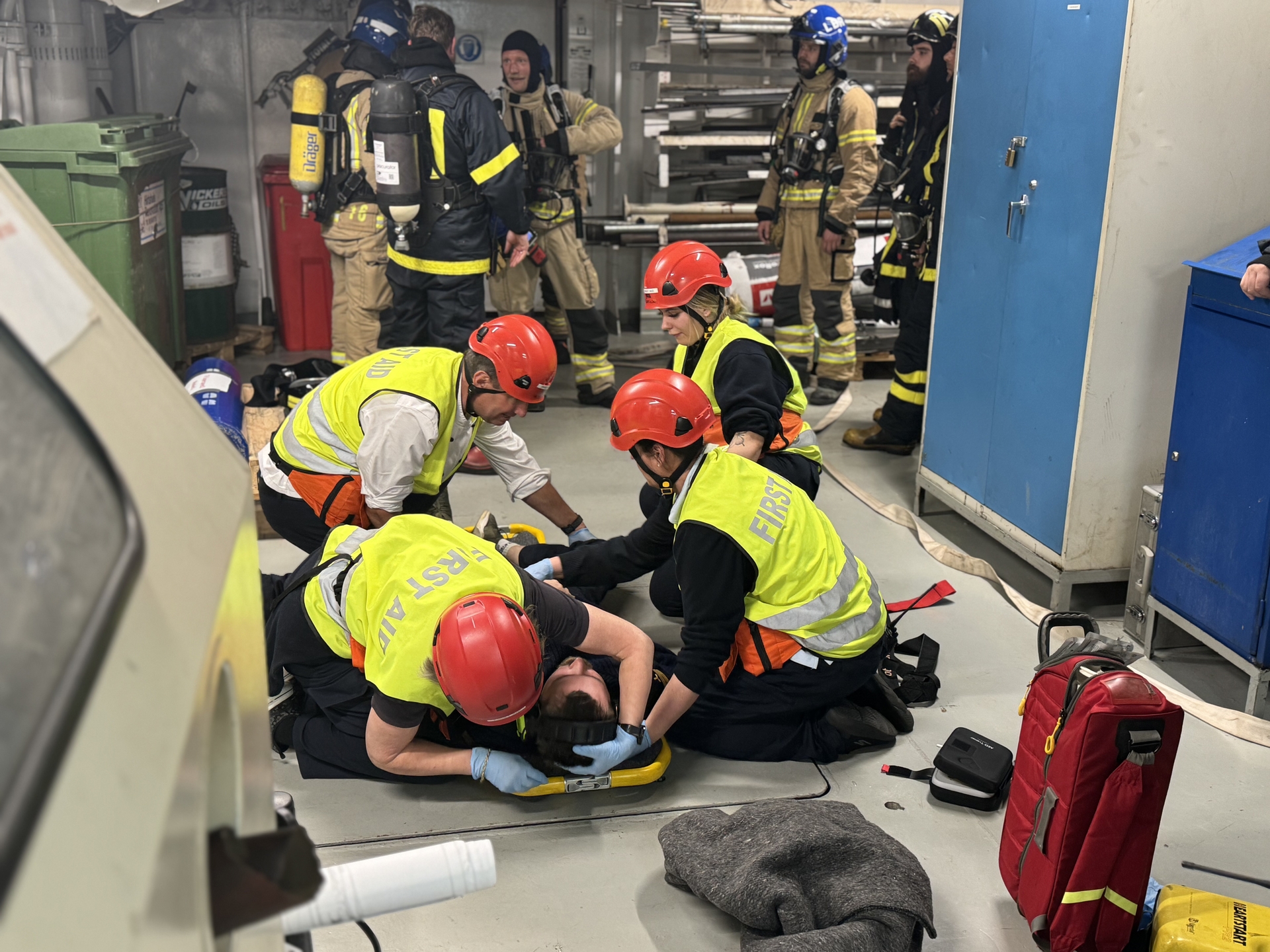
To ensure strong engagement and dialogue between the crew onboard and company management, designated contact persons are responsible for information flow and communication. Color Line also has established procedures and systems for emergency preparedness, with dedicated emergency and operations teams that regularly train and drill both at sea and on land. All safety equipment is checked, tested, and updated in accordance with regulations and the safety policy. Onboard, basic emergency medical preparedness is available for both employees and passengers.
Water and food safety are monitored by designated specialists who continuously stay updated on relevant issues, plans, and regulatory changes. Risks associated with maritime operations are systematically assessed using risk matrices, and “safe job analyses” are conducted for non-routine tasks. Employees must not perform work that is unsafe, and safety representatives are obligated to stop work that poses an immediate danger to life or health.
Color Line has several safety representatives who maintain ongoing dialogue with the company regarding work environment, health, and safety. The safety representatives are part of the company’s Health and Safety Committee (HSC), which ensures a safe working environment throughout the organization. Six HSC meetings are held on each vessel annually, and quarterly HSE inspections are conducted with participation from the vessel’s safety officer, safety representatives, and management. In addition, annual HSE inspections are conducted at all office locations in cooperation with the occupational health service, forming the basis for yearly action plans.
Color Line participates in national and international forums that promote safety and environmental protection in the maritime sector. The company works toward the joint implementation and enforcement of new requirements and regulations in the European maritime transport market.
Community Preparedness
Robust systems and procedures for handling and ensuring safety are important for society. This is achieved, among other measures, through realistic exercises in relevant environments. Color Line contributes by providing vessels as training platforms when the armed forces, police, Joint Rescue Coordination Centres, municipalities, and other agencies conduct exercises in managing critical situations. These exercises provide valuable and necessary training in incident management and coordination for all participants.
Color Line takes its societal responsibility very seriously. The company is a central and important partner for public authorities in developing maritime safety.
Jan Helge Kaiser, County Preparedness Chief, Vestfold.